The Beauty of Losing Control
The Beauty of Losing Control
BY Kelsey Sheppard
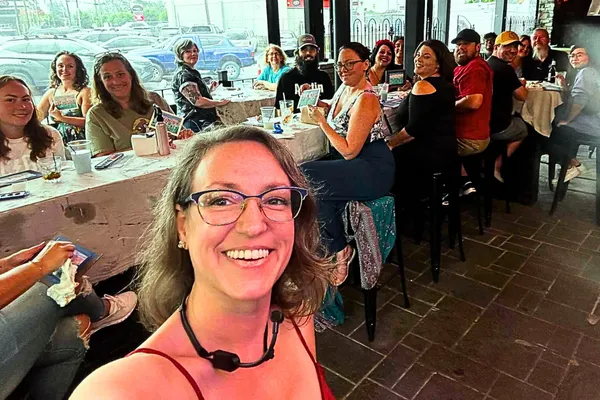
Jessie’s held more jobs than she can count, but she always found her way back to art. For a time, she taught at a Montessori school, introducing kinder-age kids to creativity. When I asked her what was her favorite thing about teaching at Paddy’s, she said it reminded her of that classroom—because adults become sponges too. There’s a kind of child-like reversion that happens. She can give the same instruction to thirty people, and everyone walks away with something different. Some go off-book entirely, gaining enough confidence to veer away from the example piece and discover what they can do.
Jessie was raised immersed in art. Her Grandma Ruby worked with wood, repurposing cradles and bassinets, passing down a sense of resourceful craftiness. Her mother served as an accountant for the Fayetteville Museum of Art, where Jessie spent hours volunteering and rubbing elbows. Despite all this, Jessie went to school for business. She was warned about the “starving artist” stereotype and encouraged to pursue something “sensible.” At 37, she broke away from that fear. She walked away from a six-figure job and decided it was time to be an artist. A crafter first and foremost, Jessie has experimented with nearly every medium, but she avoided watercolors like the plague. Watercolors terrified her. They’re uncontrollable, easily overworked. Too much water shifts the color and texture, and mistakes aren’t easily forgiven. Watercolors are fluid, unpredictable—forcing the artist either to work with delicate precision and perfect water-to-paint ratios, or to embrace accidents as the beauty of losing control.
Jessie is a perfectionist. She wants order, control. But during that season, after doing so many things that scared her, she tackled the medium that scared her most. She created 127 watercolor paintings that year.
In the process, she discovered she is an intuitive painter—drawn to nature, but in an abstract way, guided by impulse. She also decided that success in the art world is about feeling good about what you create and sustaining that feeling. To Jessie, art is karmic: giving allows you to receive. And she wants to keep that wheel turning.